Table of Contents
ToggleIs PPF Withdrawal Taxable from 2026? What Every Teacher Must Know
Sanjeev, a high school teacher, recently attended a financial literacy workshop at his school. During the Q&A, someone asked, “Will PPF withdrawals become taxable from 2026?” Sanjeev’s ears perked up. He has been investing in Public Provident Fund (PPF) for years, counting on the tax-free maturity for his retirement. The mere thought that -is ppf withdrawal taxable- made him anxious. Could this be true, or is it just a rumor? Let’s clear the air in a friendly, no-nonsense way.
PPF Tax Basics: Is PPF Withdrawal Taxable? Explaining EEE in Simple Terms
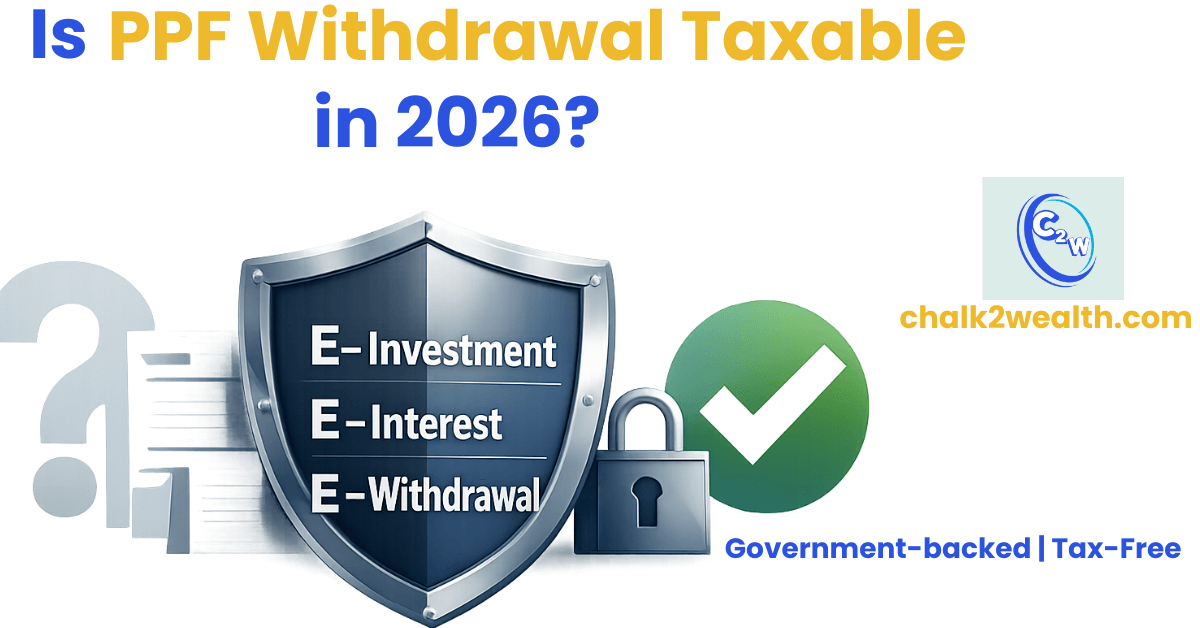
First, take a deep breath. As per Income Tax Act Section 10(11) and prevailing CBDT provisions, withdrawals from a Public Provident Fund (PPF) account are fully exempt from income tax. Under current Indian tax laws (2025), PPF continues to be completely tax-free at every stage. Many teachers keep asking, “is PPF withdrawal taxable in 2026?” — and the clear answer, as of now, is no. PPF follows the EEE (Exempt-Exempt-Exempt) structure, which works in your favour throughout the investment journey. For a clear, step-by-step breakdown, you can read our complete explanation of PPF rules and withdrawals here.
Contributions (Deposits): The amount you invest in PPF—up to ₹1.5 lakh per year—qualifies for tax deduction under Section 80C of the Income Tax Act, helping reduce your taxable income. This benefit is available if you are opting for the old tax regime.
Interest Earned: The interest credited to your PPF account every year is 100% tax-free. You do not need to pay any tax on this interest, as it is fully exempt under Section 10 of the Income Tax Act.
Withdrawals (Maturity or Partial Withdrawal): Whether you withdraw a portion after a few years or take out the full amount after maturity (15 years or more), the entire withdrawal remains tax-exempt. In fact, Section 10(11) of the Income Tax Act specifically protects PPF payouts from taxation.
Bottom line:
There is no proposal, notification, or rule change suggesting that PPF withdrawals will suddenly become taxable in 2026. Despite occasional rumours, PPF continues to enjoy its tax-free status as one of India’s safest, government-backed saving options for teachers and salaried employees.
Partial Withdrawals and Premature Closure – Still Tax-Free
Life doesn’t always wait for 15 years—and the PPF rules understand that. If a teacher ever wonders, “is PPF withdrawal taxable if I take money out early?” the answer remains no, even in these situations.
Partial Withdrawals: From the 7th financial year onward, you are allowed to withdraw a portion of your PPF balance—generally up to 50% of the eligible amount, as per the rules. These partial withdrawals are completely tax-free. Since PPF is an EEE investment, no fresh tax is levied when you take out your own money from the account. For complete clarity, you can read the exact PPF partial withdrawal rules for teachers here.
Premature Closure In genuine cases such as serious medical treatment or higher education, PPF allows premature closure after 5 years. The only cost you bear is a 1% reduction in the applicable interest rate for the completed years—this is more of a service adjustment than a penalty. Importantly, even in premature closure, the entire amount withdrawn (principal + interest) remains tax-exempt. There is no income tax on the payout, as it is still treated as a valid PPF withdrawal.
Important note: Premature closure is allowed only for specific, documented reasons—such as medical records or admission proofs—and is not meant for casual exits. However, from a tax perspective, you are fully safe.
What About 2026 and Beyond? Is PPF Withdrawal Taxable
As of now, there is no rule or proposal to make PPF withdrawals taxable from 2026. If you’re wondering “is PPF withdrawal taxable in the future?”, the answer is no under current laws.
PPF interest and withdrawals continue to remain fully tax-exempt, as confirmed by official authorities. Unless the government announces a change, you can confidently treat PPF as a safe, tax-free long-term savings option. Historically, whenever the government has changed taxation rules, existing investments have usually been grandfathered. While no one can predict future policy, sudden taxation of long-standing PPF balances is highly unlikely.
Key Takeaways: For every teacher planning retirement savings, PPF remains a reliable, tax-sheltered option. Sanjeev—and you—can rest easy knowing that PPF contributions save tax, yearly interest does not add to your tax bill, and neither maturity nor withdrawals will be taxed in 2026 under current rules. If you’re also evaluating long-term retirement choices, you may find it helpful to compare PPF with NPS for retirement planning.
Bottom line: continue investing regularly in PPF (₹500 minimum up to ₹1.5 lakh annually) and enjoy the peace of mind that comes with government-guaranteed, tax-free returns. Stay updated with official notifications, but for now, PPF’s tax benefits remain solid.
About the Author
Jagan Singh is a school leader and financial literacy educator who writes for teachers and salaried Indians. He has completed the Financial Literacy Course for Bharat conducted by NISM (National Institute of Securities Markets), a capacity-building initiative of SEBI (Securities and Exchange Board of India), and focuses on clarity, risk awareness, and long-term financial thinking.
Disclaimer: The content shared on Chalk2Wealth is for educational purposes only and does not constitute financial or investment advice. Readers are encouraged to consult qualified professionals before making financial decisions.